How can we make handovers easier for our children?
Handovers go best when they are predictable and nothing is left to argue about on the doorstep. Agree the time in advance, keep one list of what needs to travel with the child, and sort it before the day. Keep the moment itself short and warm, and save any adult conversation for later, away from the children.

How Coparity helps
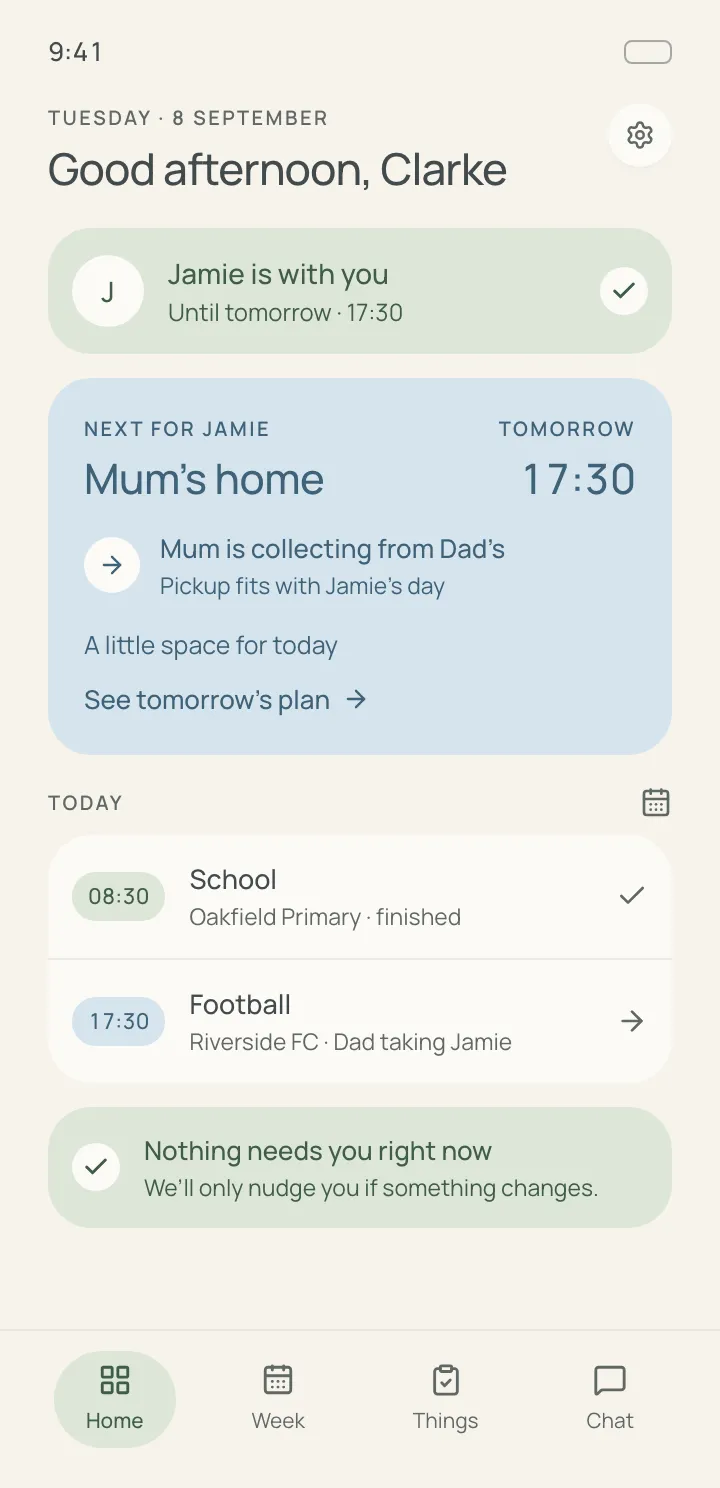
The next handover, on Home
Home opens on where the children are now and when the next handover is, so neither parent has to ask.
Things to remember
A shared list for each handover: the school bag, the medicine, the costume for Friday. Either parent adds to it.
Tick it off together
Each item is ticked in place, with an Undo. When everything is ready the card settles, and you can stop thinking about it.
Today's agenda
The day's activities and plans sit under the handover, so the evening ahead is clear too.
How it works
- Set the usual week in the calendar so Coparity knows when handovers fall.
- Add what needs to travel to the next handover's list. Your co-parent sees it too.
- Tick things off as they're packed. The card settles once it's all ready.
Who sees what. Handover times and their lists are shared by both parents, so the list is the same in both homes.
Questions parents ask
What should we put on a handover list?
Anything a child would miss: school uniform and books, medicines, a comfort toy, sports kit, chargers, and anything a teacher or club has asked for that week.
Where should handovers happen?
Somewhere neutral and routine works for many families, such as school or nursery pick-up, so the children aren't watching an exchange on a doorstep. Agree what works for yours.
What if we can't agree a time?
Home asks you to agree a time when one isn't set. If talking directly is hard, Mediate can help you put a clear proposal to your co-parent.
Does the other parent get told when I tick something?
They see the same list, so they can see what's ready. It's there to save a message, not to keep score.